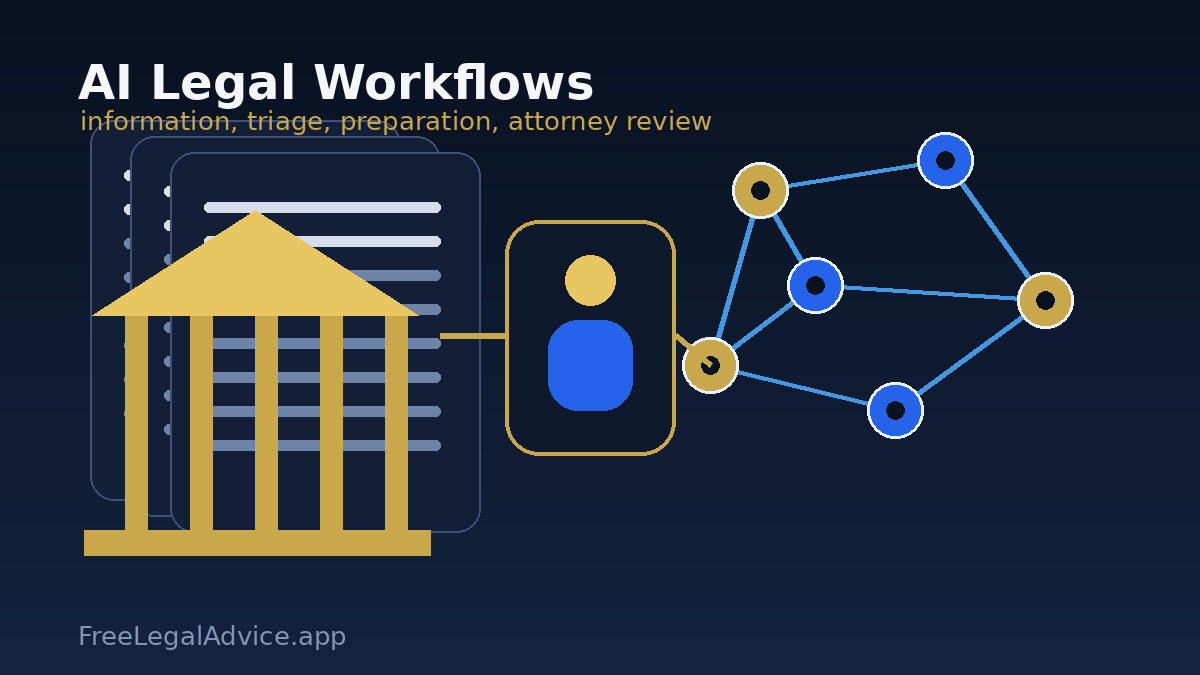
A new Artificial Lawyer write-up of Deloitte Legal's report, The AI imperative: Reshaping the Legal industry, points to a big shift in how legal work may get done.
According to the article, Deloitte Legal's market analysis suggests that within the next three to five years, AI agents could handle 30% of the work inside corporate legal teams. The same analysis says 20% of in-house legal teams may include hybrid engineer-lawyers — lawyers who can also build, configure, or manage legal technology workflows.
That does not mean robots are replacing lawyers tomorrow. It means legal work is being split into pieces: some require legal judgment, negotiation, privilege, ethics, or representation; others start with information gathering, issue spotting, plain-English explanation, checklist creation, and first-draft preparation.
The corporate legal shift is a signal for consumers
Deloitte's projection is about corporate legal departments, not everyday consumer legal problems. But the direction matters. If large legal teams expect AI agents to help with routine workflows, consumers should expect legal help to become more layered too.
- AI for first-pass explanation — understanding the issue, the vocabulary, and the likely next steps.
- AI for preparation — organizing facts, drafting questions, outlining documents, and building checklists.
- Attorneys for legal advice and representation — applying the law to a specific situation, negotiating, appearing in court, or handling high-risk decisions.
That is a healthier model than pretending every legal question needs a $400/hour conversation — or pretending AI can replace lawyers entirely.
What Deloitte's numbers suggest
The Artificial Lawyer article highlights several numbers from Deloitte's analysis:
- AI agents could handle 30% of in-house legal work over the next 3–5 years.
- 20% of in-house teams may become hybrid engineer-lawyer roles.
- 85% of respondents believe AI will change law-firm pricing to at least a moderate extent.
- Hourly-rate work is expected by respondents to fall from 72% today to 44% within 2–3 years.
- General Counsel could reduce external legal spend by 20–40% over three years through AI benefits and more insourcing.
- 58% of General Counsel say outside providers rarely or never proactively discuss AI benefits.
- Only 4% have directly experienced benefits from law firms' AI use.
Those numbers are projections and survey signals, not guarantees. Artificial Lawyer itself is skeptical that hourly billing will shift that quickly. But the signal is clear: buyers of legal services want more efficiency, more transparency, and more value from technology.
AI legal help should not pretend to be a lawyer
For consumers, the safest way to think about AI legal tools is simple: AI legal tools are useful for legal information, preparation, and triage. They are not a substitute for a licensed attorney when you need legal advice.
A good AI legal assistant can help you understand legal terms, identify what kind of issue you may have, organize facts and timelines, prepare questions for a lawyer, draft a demand letter or checklist for review, and identify when a licensed attorney is likely needed.
The real opportunity: lower the first-step barrier
The legal system has a first-step problem. Many people wait too long because they do not know what their issue is called, what deadline applies, what documents matter, or whether the problem is serious enough to call an attorney.
AI legal tools can make the first 20 minutes of legal orientation free, fast, and less intimidating. The best outcome is not an AI-only legal system. The best outcome is a better front door: AI explains the basics, the user gets organized, the system identifies risk, and a licensed attorney steps in when advice or representation is needed.
What consumers should watch for
- Does it clearly say it is not a law firm?
- Does it explain the difference between legal information and legal advice?
- Does it recommend attorney review for high-risk situations?
- Does it avoid guaranteeing outcomes?
- Does it help you prepare better questions and documents?
If a tool acts like it can replace a lawyer in every situation, be careful.
Bottom line
Deloitte's projection does not mean AI agents will replace lawyers. It means legal work is being reorganized. Routine information work, preparation, triage, and drafting will increasingly move into AI-assisted workflows. Licensed attorneys still matter most when the stakes are specific, adversarial, regulated, or strategic.
Start with AI to understand the issue. Use it to get organized. Then bring in a licensed attorney when your situation requires legal advice, negotiation, court action, or representation.